

Nvidia Open Sources Latest VLA—Can It Break Through L4 Autonomous Driving Barriers?
As large AI models are increasingly integrated into the automotive industry, competition in the sector is shifting from basic functionality to high-level intelligent driving capabilities. The VLA (Vision-Language-Action Model) is now seen as the key variable driving the next wave of technological advancement.
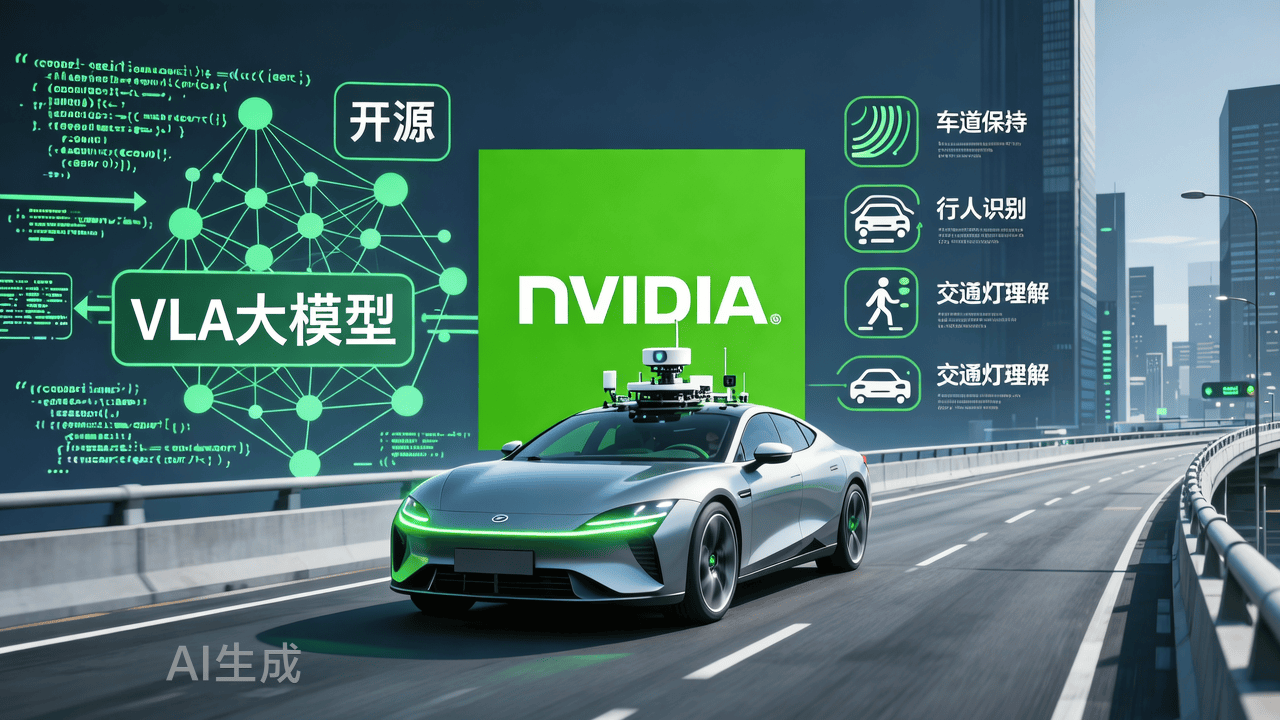
On December 1, NVIDIA officially announced the open-sourcing of its latest autonomous driving Vision-Language-Action (VLA) model, Alpamayo-R1. This model can simultaneously process vehicle camera footage and textual instructions to output driving decisions. It is now open-sourced on both GitHub and Hugging Face, with the release of the Cosmos Cookbook development toolkit.
This marks the industry’s first open-source VLA model dedicated to autonomous driving. NVIDIA aims to use this move to provide core technical support for the adoption of L4-level autonomous driving.
Notably, compared with traditional black-box autonomous driving algorithms, NVIDIA’s Alpamayo-R1 emphasizes explainability, capable of providing the reasoning behind its decisions. This feature assists with safety validation, regulatory review, and accident liability determination. Accompanying tools like the Cosmos Cookbookmake it easier for companies and developers to efficiently train, evaluate, and deploy solutions.
Industry experts believe NVIDIA is attempting to lower development barriers, accelerate the standardization of the software stack, and break away from the costly “fully in-house development” approach prevalent in Robotaxi operations. The goal is to create an “Android-style” ecosystem that allows for rapid modular assembly.
However, some insiders told the author that NVIDIA’s open-sourcing of Alpamayo-R1 is similar to Baidu’s Apollo initiative: valuable for newcomers to the autonomous driving field, but not particularly significant for established, specialized companies.
Currently, VLA technology is widely recognized as the next-generation core for intelligent driving, prompting increased investment from major players. In China, companies such as Li Auto, XPeng Motors, GWM (already applied in the Wey Lanshan model), and DeepRoute have all achieved mass production deployments based on VLA.